Start online
97%of real estate buyers begin their search online before contacting anyone

A real estate firm or development can have the best portfolio in its market and lose qualified prospects every week because its digital presence isn't built for the level of decision that a property purchase represents. The buyer doesn't arrive at the site to browse casually — they arrive with real intent, a defined budget, and a level of demand proportional to what they're about to invest. If what they find isn't up to that standard, they leave without saying a word.
Pimentone approaches this industry from the psychology of the real estate decision, not from the photo gallery. We build digital infrastructure that generates trust before the first contact, presents the portfolio at the level it deserves, and converts visits into qualified prospects — without depending exclusively on portals the brand doesn't control.
Start online
97%of real estate buyers begin their search online before contacting anyone
Weeks of research
10+is the average time a property buyer researches online before their first direct contact
Disqualify without contacting
74%of prospects rule out a property or development based solely on its digital presence
Higher closing rate
3xachieved by developments with high-level digital infrastructure vs those that rely only on portals
The reality
The qualified real estate prospect doesn't wait for a call to evaluate — they've already decided before the sales team even knows they exist. Digital infrastructure doesn't support the sales process. It is the sales process.

01
The real estate buyer arrives at a development's site with a mix of desire and skepticism. They want to believe in the project — but they need solid signals before committing their attention. The firm's track record, the quality of the project's presentation, and the coherence between what's promised and what's shown determine whether that prospect takes the next step or disappears.
02
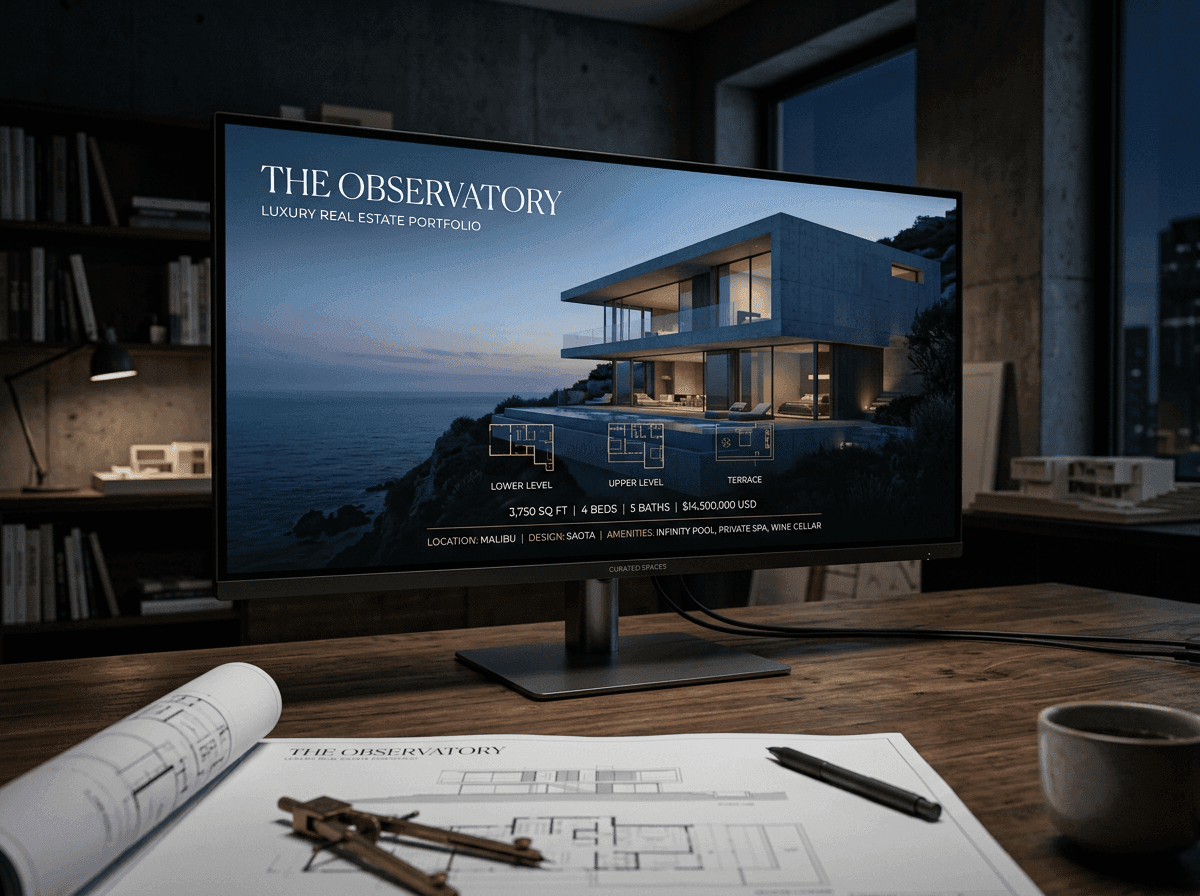
A property presented with judgment — quality renders, readable floor plans, clear specifications, contextualized location — generates a perception of value that goes beyond price per square meter. One presented with generic photos and brochure text communicates exactly the opposite. In high-end real estate, how you present is part of the price.

03
The serious buyer who found the development, researched the firm, and decided it deserves their time shouldn't encounter a generic contact form as the only point of entry. The contact system must be designed for the prospect's level — with clear options, immediate response, and an experience that confirms this firm operates to the same standard as its product.
Every development has its proposition. The digital problems limiting their prospect conversion are almost always the same.
The development has first-rate architecture, location, and specifications. But the site doesn't reflect it — small renders, incomplete information, confusing navigation. The prospect who arrived with real interest doesn't find the level they expected and disappears without a trace.
The digital strategy is reduced to listing on portals the brand doesn't control, where the development competes on the same page with dozens of similar options. There's no owned channel, no brand experience, and every lead has a cost that builds no asset.
A real estate decision can take months. Most firms have no digital infrastructure to stay present throughout that process — no automations, no content that accompanies the journey, and no system that detects when a prospect is ready to move forward.
The qualified prospect who decided to show interest encounters a generic form, a delayed response, or a process that doesn't transmit the same level as the development they're considering buying. The first impression from the human team arrives late and falls short.
Before designing any screen, we map who the buyer of this development is — how they research, what they validate, what signals they need to find, and at what point in the process they're ready to make contact. The right digital architecture is designed for that specific buyer, not a generic real estate buyer.
We don't build image galleries. We build presentation experiences that elevate the perceived value of the development — with renders that look like luxury renders, information structured for the decision-making process, and a narrative that makes the project justify itself before the sales team ever steps in.
We design infrastructure that generates qualified prospects organically and directly — without depending exclusively on portals or paid advertising. A well-built digital asset works every day, and each prospect it generates has a marginal cost that decreases over time.
The infrastructure is designed to evolve — new phases, new projects, new markets. A well-built system absorbs that growth without breaking down and without needing to be replaced every time the portfolio expands.